Showing posts with label Computer Vision. Show all posts

KeyPose: Estimating the 3D Pose of Transparent Objects from Stereo

Estimating the position and orientation of 3D objects is one of the core problems in computer vision applications that involve object-level perception, such as augmented reality and robotic manipulation. In these applications, it is important to know the 3D position of objects in the world, either to directly affect them, or to place simulated objects correctly around them. While there has been much research on this topic using machine learning (ML) techniques, especially Deep Nets, most have relied on the use of depth sensing devices, such as the Kinect, which give direct measurements of the distance to an object. For objects that are shiny or transparent, direct depth sensing does not work well. For example, the figure below includes a number of objects (left), two of which are transparent stars. A depth device does not find good depth values for the stars, and gives a very poor reconstruction of the actual 3D points (right).

Left: RGB image of transparent objects.  Right: A four-panel image showing the reconstructed depth for the scene on the left.The top row includes depth images and the bottom row presents the 3D point cloud. The left panels were reconstructed using a depth camera and the right panels are output from the ClearGrasp model.  Note that although ClearGrasp inpaints the depth of the stars, it mistakes the actual depth of the rightmost one.

One solution to this problem, such as that proposed by ClearGrasp, is to use a deep neural network to inpaint the corrupted depth map of the transparent objects. Given a single RGB-D image of transparent objects, ClearGrasp uses deep convolutional networks to infer surface normals, masks of transparent surfaces, and occlusion boundaries, which it uses to refine the initial depth estimates for all transparent surfaces in the scene (far right in the figure above). This approach is very promising, and allows scenes with transparent objects to be processed by pose-estimation methods that rely on depth.  But inpainting can be tricky, especially when trained completely with synthetic images, and can still result in errors in depth.

In “KeyPose: Multi-View 3D Labeling and Keypoint Estimation for Transparent Objects”, presented at CVPR 2020 in collaboration with the Stanford AI Lab, we describe an ML system that estimates the depth of transparent objects by directly predicting 3D keypoints. To train the system we gather a large real-world dataset of images of transparent objects in a semi-automated way, and efficiently label their pose using 3D keypoints selected by hand. We then train deep models (called KeyPose) to estimate the 3D keypoints end-to-end from monocular or stereo images, without explicitly computing depth. The models work on objects both seen and unseen during training, for both individual objects and categories of objects. While KeyPose can work with monocular images, the extra information available from stereo images allows it to improve its results by a factor of two over monocular image input, with typical errors from 5 mm to 10 mm, depending on the objects. It substantially improves over state-of-the-art in pose estimation for these objects, even when competing methods are provided with ground truth depth. We are releasing the dataset of keypoint-labeled transparent objects for use by the research community.

Real-World Transparent Object Dataset with 3D Keypoint Labels
To facilitate gathering large quantities of real-world images, we set up a robotic data-gathering system in which a robot arm moves through a trajectory while taking video with two devices, a stereo camera and the Kinect Azure depth camera.

Automated image sequence capture using a robot arm with a stereo camera and an Azure Kinect device.

The AprilTags on the target enable accurate tracing of the pose of the cameras. By hand-labelling only a few images in each video with 2D keypoints, we can extract 3D keypoints for all frames of the video using multi-view geometry, thus increasing the labelling efficiency by a factor of 100.

We captured imagery for 15 different transparent objects in five categories, using 10 different background textures and four different poses for each object, yielding a total of 600 video sequences comprising 48k stereo and depth images. We also captured the same images with an opaque version of the object, to provide accurate ground truth depth images. All the images are labelled with 3D keypoints. We are releasing this dataset of real-world images publicly, complementing the synthetic ClearGrasp dataset with which it shares similar objects.

KeyPose Algorithm Using Early Fusion Stereo
The idea of using stereo images directly for keypoint estimation was developed independently for this project; it has also appeared recently in the context of hand-tracking. The diagram below shows the basic idea: the two images from a stereo camera are cropped around the object and fed to the KeyPose network, which predicts a sparse set of 3D keypoints that represent the 3D pose of the object. The network is trained using supervision from the labelled 3D keypoints.

One of the key aspects of stereo KeyPose is the use of early fusion to intermix the stereo images, and allow the network to implicitly compute disparity, in contrast to late fusion, in which keypoints are predicted for each image separately, and then combined. As shown in the diagram below, the output of KeyPose is a 2D keypoint heatmap in the image plane along with a disparity (i.e., inverse depth) heatmap for each keypoint. The combination of these two heatmaps yields the 3D coordinate of the keypoint, for each keypoint.

Keypose system diagram. Stereo images are passed to a CNN model to produce a probability heatmap for each keypoint.  This heatmap yields 2D image coordinates U,V for the keypoint.  The CNN model also produces a disparity (inverse depth) heatmap for each keypoint, which when combined with the U,V coordinates, gives a 3D position (X,Y,Z).

When compared to late fusion or to monocular input, early fusion stereo typically is twice as accurate.

Results
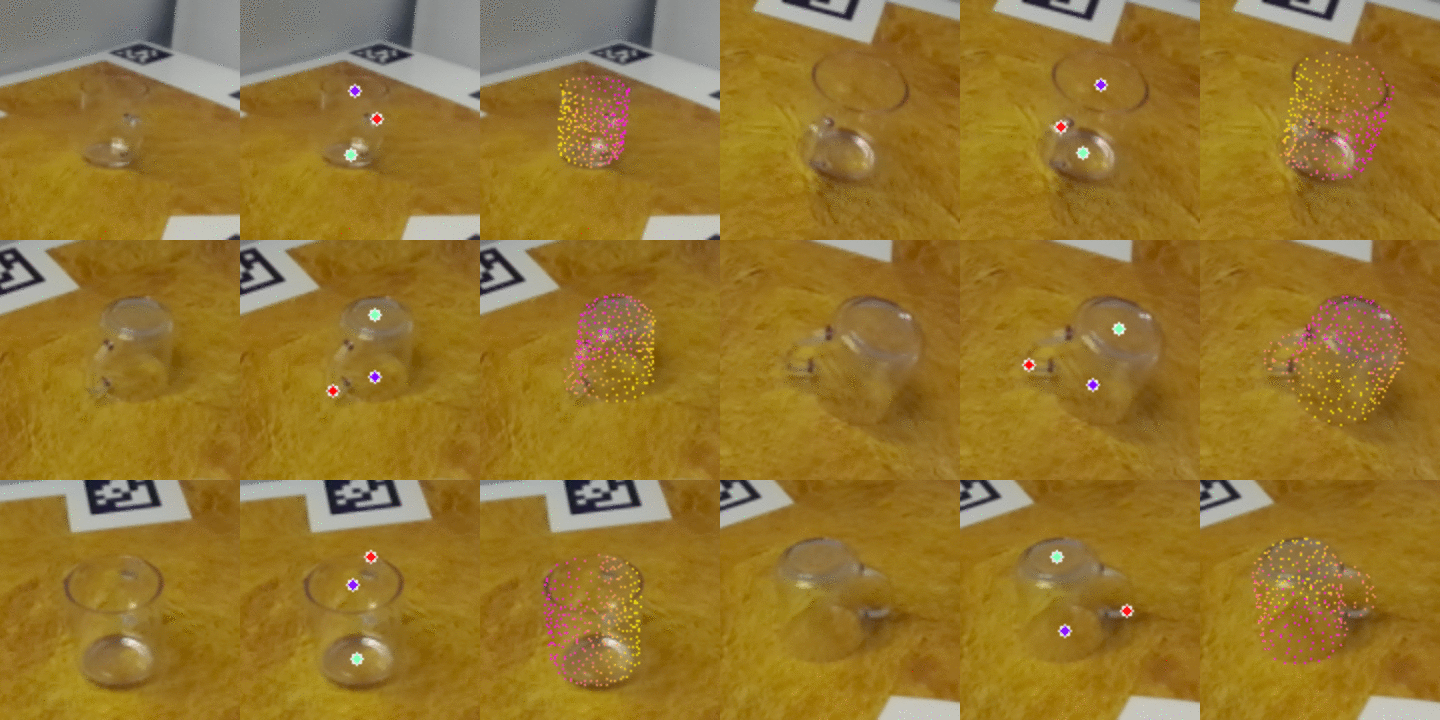
The images below show qualitative results of KeyPose on individual objects. On the left is one of the original stereo images; in the middle are the predicted 3D keypoints projected onto the image. On the right, we visualize points from a 3D model of the bottle, placed at the pose determined by the predicted 3D keypoints. The network is efficient and accurate, predicting keypoints with an MAE of 5.2 mm for the bottle and 10.1 mm for the mug using just 5 ms on a standard GPU.

The following table shows results for KeyPose on category-level estimation. The test set used a background texture not seen by the training set. Note that the MAE varies from 5.8 mm to 9.9 mm, showing the accuracy of the method.

Quantitative comparison of KeyPose with the state-of-the-art DenseFusion system, on category-level data. We provide DenseFusion with two versions of depth, one from the transparent objects, and one from opaque objects. <2cm is the percent of estimates with errors less than 2 cm. MAE is the mean absolute error of the keypoints, in mm.

For a complete accounting of quantitative results, as well as, ablation studies, please see the paper and supplementary materials and the KeyPose website.

Conclusion
This work shows that it is possible to accurately estimate the 3D pose of transparent objects from RGB images without reliance on depth images. It validates the use of stereo images as input to an early fusion deep net, where the network is trained to extract sparse 3D keypoints directly from the stereo pair. We hope the availability of an extensive, labelled dataset of transparent objects will help to advance the field. Finally, while we used semi-automatic methods to efficiently label the dataset, we hope to employ self-supervision methods in future work to do away with manual labelling.

Acknowledgements
I want to thank my co-authors, Xingyu Liu of Stanford University, and Rico Jonschkowski and Anelia Angelova; as well the many who helped us through discussions during the project and paper writing, including Andy Zheng, Shuran Song, Vincent Vanhoucke, Pete Florence, and Jonathan Tompson.

Axial-DeepLab: Long-Range Modeling in All Layers for Panoptic Segmentation

The success of convolutional neural networks (CNNs) mainly comes from two properties of convolution: translation equivariance and locality. Translation equivariance, although not exact, ensures that the model functions well for objects at different positions in an image or for images of different sizes. Locality ensures efficient computation, but at the cost of making the modeling of long-range spatial relations challenging for panoptic segmentation of large images. For example, segmenting a large object requires modeling the shape of it, which could potentially cover a very large pixel area, and context that could be helpful for segmenting the object may come from farther away. In such cases, the inability to inform the model from context far from the convolution kernel could negatively impact the performance.

A rich set of literature has discussed approaches to solving the limitation of locality and enabling long-range interactions in CNNs. Some employ atrous convolutions, or image pyramids, which expand the receptive field somewhat, but it is still limited to a small local region. Another line of work adopts self-attention mechanisms, e.g., non-local neural networks, which allow the receptive field to cover the entire input image, as opposed to local convolutions. Unfortunately, such approaches are computationally expensive, especially for large inputs. Recent works enable building fully attentional models, but at a cost of applying local constraints to non-local neural networks. These restrictions limit the model receptive field, which is harmful to tasks such as segmentation, especially on high-resolution inputs.

In our recent ECCV 2020 paper, “Axial-DeepLab: Stand-Alone Axial-Attention for Panoptic Segmentation”, we propose to adopt axial-attention (or criss-cross attention), which recovers large receptive field in fully attentional models. The core idea is to separate 2D attention into two steps that apply 1D attention in the height and width axes sequentially. The efficiency of this approach enables attention over large regions, allowing models that learn long-range, or even global, interactions. Additionally, we propose a novel formulation for self-attention modules, which is more sensitive to the position of relevant context in a large receptive field with marginal costs. We evaluate our position-sensitive axial-attention method on panoptic segmentation by applying it to Panoptic-DeepLab, a simple and efficient method for panoptic segmentation. The effectiveness of our model is demonstrated on ImageNet, COCO, and Cityscapes. Axial-DeepLab achieves state-of-the-art results on panoptic segmentation and semantic segmentation, outperforming Panoptic-DeepLab by a large margin.

Axial-Attention Architecture
Axial-DeepLab consists of an Axial-ResNet backbone and Panoptic-DeepLab output heads, which produce panoptic segmentation results. Our Axial-ResNet is built on a ResNet architecture, in which all the 3×3 local convolutions in the ResNet bottleneck blocks are replaced by our proposed global position-sensitive axial-attention, thus enabling both a large receptive field and precise positional information.

An axial-attention block consists of two position-sensitive axial-attention layers operating along height- and width-axis sequentially.

The Axial-DeepLab height axial attention layer provides 1-dimensional self-attention globally, propagating information within individual columns — it does not transfer information between columns. The second 1D attention layer operating in the horizontal direction allows one to capture both column-wise and row-wise information. This separation reduces the complexity of self-attention from quadratic (2D) to linear (1D), which enables using a much larger (65×65 vs. previously 3×3) or even global context in all layers for long-range modeling in panoptic segmentation.

A message can be passed globally with two hops.

Note that a message or feature vector at (x1, y1) can always be passed globally on a 2D lattice to any position (x2, y2), with one hop on the height-axis (x1, y1 →x1, y2), followed by another hop on the width axis (x1, y2 → x2, y2). In this way, we are able to model 2D long-range relations in a single residual block. This axial-attention design also reduces the complexity from quadratic to linear and enables global receptive fields in all layers of a model.

Position-Sensitive Self-Attention
Additionally, we propose a position-sensitive formulation for self-attention. Previous self-attention formulations enabled a given pixel A to aggregate long-range context B, but provided no information about where in the receptive field the context originated. For example, perhaps the feature at pixel A represents the eye of a cat, and the context B might be the nose and another eye. In this case, the aggregated feature at pixel A would be a nose and two eyes, regardless of the geometric structure of a face. This could cause a false indication of the presence of a face when the two eyes are on the bottom-left of an image and the nose is on the top-right. A recently proposed solution is to impose a positional bias on where in the receptive field the context can originate. This bias depends on the feature at A only, (an eye), but not the feature at B, which contains important contextual information.

In this work, we let this bias also depend on the context feature at B (i.e., the nose and another eye). This change enables a more accurate positional bias when a pixel and the context informing it are far away from one another and thus contains different information about the bias. In addition, when pixel A aggregates the context feature B, we also include a feature that indicates the relative position from A to B. This change enables A to know precisely where B originated. These two changes make self-attention position-sensitive, especially in the situation of long-range modeling.

Results
We have tested Axial-DeepLab on COCO, and Cityscapes for panoptic segmentation. Improvements over the state-of-the-art Panoptic-DeepLab for each dataset can be seen in the table below. In particular, our Axial-DeepLab outperforms Panoptic-DeepLab by 2.8% Panoptic Quality (PQ) on the COCO test-dev set. Our single-scale small model performs better than multi-scale Panoptic-DeepLab while improving computational efficiency by 27x and using only 1/4 the number of parameters. We also show state-of-the-art results on Cityscapes. Moreover, we find that the performance increases as the block receptive field increases from 5 × 5 to 65 × 65. Our model is also more robust to out-of-distribution scales, on which the model was not trained.

Model     COCO     Citiscapes
Panoptic-DeepLab     39.7     65.3
Axial-DeepLab (ours)     43.4 (+3.7)     66.5 (+1.2)
Single scale comparison with Panoptic-DeepLab on validation sets

Besides our main results on panoptic segmentation, our full axial-attention model, Axial-ResNet, also performs better than the previous best stand-alone self-attention model on ImageNet.

Model     Params     M-Adds     Top-1
ResNet-50     25.6M     4.1B     76.9
Stand-Alone     18.0M     3.6B     77.6
Full Axial-Attention (ours)     12.5M     3.3B     78.1
Full Axial-Attention also works well on ImageNet.

Conclusion
We have proposed and demonstrated the effectiveness of position-sensitive axial-attention on image classification and panoptic segmentation. On ImageNet, our Axial-ResNet, formed by stacking axial-attention blocks, achieves state-of-the-art results among stand-alone self-attention models. We further convert Axial-ResNet to Axial-DeepLab for bottom-up panoptic segmentation, and also show state-of-the-art performance on several benchmarks, including COCO, and Cityscapes. We hope our promising results could establish that axial-attention is an effective building block for modern computer vision models.

Acknowledgements
This post reflects the work of the authors as well as Bradley Green, Hartwig Adam, Alan Yuille, and Liang-Chieh Chen. We also thank Niki Parmar for discussion and support; Ashish Vaswani, Xuhui Jia, Raviteja Vemulapalli, Zhuoran Shen for their insightful comments and suggestions; Maxwell Collins and Blake Hechtman for technical support.

Understanding View Selection for Contrastive Learning

Most people take for granted the ability to view an object from several different angles, but still recognize that it's the same object— a dog viewed from the front is still a dog when viewed from the side. While people do this naturally, computer scientists need to explicitly enable machines to learn representations that are view-invariant, with the goal of seeking robust data representations that retain information that is useful to downstream tasks.

Of course, in order to learn these representations, manually annotated training data can be used. However, as in many cases such annotations aren’t available, which gives rise to a series of self- and crossmodal supervised approaches that do not require manually annotated training data. Currently, a popular paradigm for training with such data is contrastive multiview learning, where two views of the same scene (for example, different image channels, augmentations of the same image, and video and text pairs) will tend to converge in representation space while two views of different scenes diverge. Despite their success, one important question remains: “If one doesn’t have annotated labels readily available, how does one select the views to which the representations should be invariant?” In other words, how does one identify an object using information that resides in the pixels of the image itself, while still remaining accurate when that image is viewed from disparate viewpoints?

In “What makes for good views for contrastive learning”, we use theoretical and empirical analysis to better understand the importance of view selection, and argue that one should reduce the mutual information between views while keeping task-relevant information intact. To verify this hypothesis, we devise unsupervised and semi-supervised frameworks that learn effective views by aiming to reduce their mutual information. We also consider data augmentation as a way to reduce mutual information, and show that increasing data augmentation indeed leads to decreasing mutual information while improving downstream classification accuracy. To encourage further research in this space, we have open-sourced the code and pre-trained models.

The InfoMin Hypothesis
The goal of contrastive multiview learning is to learn a parametric encoder, whose output representations can be used to discriminate between pairs of views with the same identities, and pairs with different identities. The amount and type of information shared between the views determines how well the resulting model performs on downstream tasks. We hypothesize that the views that yield the best results should discard as much information in the input as possible except for the task relevant information (e.g., object labels), which we call the InfoMin principle.

Consider the example below in which two patches of the same image represent the different “views”. The training objective is to identify that the two views belong to the same image. It is undesirable to have views that share too much information, for example, where low-level color and texture cues can be exploited as “shortcuts” (left), or to have views that share too little information to identify that they belong to the same image (right). Rather, views at the “sweet spot” share the information related to downstream tasks, such as patches corresponding to different parts of the panda for an object classification task (center).

An illustration of three regimes of information captured during contrastive multiview learning. Views should not share too much information (left) or too little information (right), but should find an optimal mix (the “sweet spot”, middle) that maximizes the downstream performance.

A Unified View on Contrastive Learning
We design several sets of experiments to verify the InfoMin hypothesis, motivated by the fact that there are simple ways to control the mutual information shared between views without any supervision. For example, we can sample different patches from the same images, and reduce their mutual information simply by increasing the distance between the patches. Here, we estimate the mutual information using InfoNCE (INCE), which is a quantitative measure of the mutual information lower bound.. Indeed, we observe a reverse U-shape curve: as mutual information is reduced, the downstream task accuracy first increases and then begins to decrease.

Downstream classification accuracy on STL-10 (left) and CIFAR-10 (right) by applying linear classifiers on representations learned with contrastive learning. Same as the previous illustration, the views are sampled as different patches from the same images. Increasing the Euclidean distance between patches leads to decreasing mutual information. A reverse U-shape curve between classification accuracy and INCE (patch distance) is observed.

Furthermore, we demonstrate that several state-of-the-art contrastive learning methods (InstDis, MoCo, CMC, PIRL, SimCLR and CPC) can be unified through the perspective of view selection: despite the differences in architecture, objective and engineering details, all recent contrastive learning methods create two views that implicitly follow the InfoMin hypothesis, where the information shared between views are controlled by the strength of data augmentation. Motivated by this, we propose a new set of data augmentations, which outperforms the prior state of the art, SimCLR, by nearly 4% on the ImageNet linear readout benchmark. We also found that transferring our unsupervised pre-trained models to object detection and instance segmentation consistently outperforms ImageNet pre-training.

Learning to Generate Views
In our work, we design unsupervised and semi-supervised methods that synthesize novel views following the InfoMin hypothesis. We learn flow-based models that transfer natural color spaces into novel color spaces, from which we split the channels to get views. For the unsupervised setup, the view generators are optimized to minimize the InfoNCE bound between views. As shown in the results below, we observe a similar reverse U-shape trend while minimizing the InfoNCE bound.

View generators learned by unsupervised (left) and semi-supervised (right) objectives.

To reach the sweet spot without overly minimizing mutual information, we can use the semi-supervised setup and guide the view generator to retain label information. As expected, all learned views are now centered around the sweet spot, no matter what the input color space is.

Code and Pretrained Models
To accelerate research in self-supervised contastive learning, we are excited to share the code and pretrained models of InfoMin with the academic community. They can be found here.

Acknowledgements
The core team includes Yonglong Tian, Chen Sun, Ben Poole, Dilip Krishnan, Cordelia Schmid and Phillip Isola. We would like to thank Kevin Murphy for insightful discussion; Lucas Beyer for feedback on the manuscript; and the Google Cloud team for computation support.

On-device, Real-time Body Pose Tracking with MediaPipe BlazePose

Pose estimation from video plays a critical role enabling the overlay of digital content and information on top of the physical world in augmented reality, sign language recognition, full-body gesture control, and even quantifying physical exercises, where it can form the basis for yoga, dance, and fitness applications. Pose estimation for fitness applications is particularly challenging due to the wide variety of possible poses (e.g., hundreds of yoga asanas), numerous degrees of freedom, occlusions (e.g. the body or other objects occlude limbs as seen from the camera), and a variety of appearances or outfits.

BlazePose results on fitness and dance use-cases.

Today we are announcing the release of a new approach to human body pose perception, BlazePose, which we presented at the CV4ARVR workshop at CVPR 2020. Our approach provides human pose tracking by employing machine learning (ML) to infer 33, 2D landmarks of a body from a single frame. In contrast to current pose models based on the standard COCO topology, BlazePose accurately localizes more keypoints, making it uniquely suited for fitness applications. In addition, current state-of-the-art approaches rely primarily on powerful desktop environments for inference, whereas our method achieves real-time performance on mobile phones with CPU inference. If one leverages GPU inference, BlazePose achieves super-real-time performance, enabling it to run subsequent ML models, like face or hand tracking.

Upper-body BlazePose model in MediaPipe

Topology
The current standard for human body pose is the COCO topology, which consists of 17 landmarks across the torso, arms, legs, and face. However, the COCO keypoints only localize to the ankle and wrist points, lacking scale and orientation information for hands and feet, which is vital for practical applications like fitness and dance. The inclusion of more keypoints is crucial for the subsequent application of domain-specific pose estimation models, like those for hands, face, or feet.

With BlazePose, we present a new topology of 33 human body keypoints, which is a superset of COCO, BlazeFace and BlazePalm topologies. This allows us to determine body semantics from pose prediction alone that is consistent with face and hand models.

BlazePose 33 keypoint topology as COCO (colored with green) superset

Overview: An ML Pipeline for Pose Tracking
For pose estimation, we utilize our proven two-step detector-tracker ML pipeline. Using a detector, this pipeline first locates the pose region-of-interest (ROI) within the frame. The tracker subsequently predicts all 33 pose keypoints from this ROI. Note that for video use cases, the detector is run only on the first frame. For subsequent frames we derive the ROI from the previous frame’s pose keypoints as discussed below.

Human pose estimation pipeline overview.

Pose Detection by extending BlazeFace
For real-time performance of the full ML pipeline consisting of pose detection and tracking models, each component must be very fast, using only a few milliseconds per frame. To accomplish this, we observe that the strongest signal to the neural network about the position of the torso is the person's face (due to its high-contrast features and comparably small variations in appearance). Therefore, we achieve a fast and lightweight pose detector by making the strong (yet for many mobile and web applications valid) assumption that the head should be visible for our single-person use case.

Consequently, we trained a face detector, inspired by our sub-millisecond BlazeFace model, as a proxy for a pose detector. Note, this model only detects the location of a person within the frame and can not be used to identify individuals. In contrast to the Face Mesh and MediaPipe Hand tracking pipelines, where we derive the ROI from predicted keypoints, for the human pose tracking we explicitly predict two additional virtual keypoints that firmly describe the human body center, rotation and scale as a circle. Inspired by Leonardo’s Vitruvian man, we predict the midpoint of a person's hips, the radius of a circle circumscribing the whole person, and the incline angle of the line connecting the shoulder and hip midpoints. This results in consistent tracking even for very complicated cases, like specific yoga asanas. The figure below illustrates the approach.

Vitruvian man aligned via two virtual keypoints predicted by our BlazePose detector in addition to the face bounding box

Tracking Model
The pose estimation component of the pipeline predicts the location of all 33 person keypoints with three degrees of freedom each (x, y location and visibility) plus the two virtual alignment keypoints described above. Unlike current approaches that employ compute-intensive heatmap prediction, our model uses a regression approach that is supervised by a combined heat map/offset prediction of all keypoints, as shown below.

Tracking network architecture: regression with heatmap supervision

Specifically, during training we first employ a heatmap and offset loss to train the center and left tower of the network. We then remove the heatmap output and train the regression encoder (right tower), thus, effectively using the heatmap to supervise a lightweight embedding.

The table below shows an ablation study of the model quality resulting from different training strategies. As an evaluation metric, we use the Percent of Correct Points with 20% tolerance (PCK@0.2) (where we assume the point to be detected correctly if the 2D Euclidean error is smaller than 20% of the corresponding person’s torso size). To obtain a human baseline, we asked annotators to annotate several samples redundantly and obtained an average PCK@0.2 of 97.2. The training and validation have been done on a geo-diverse dataset of various poses, sampled uniformly.

To cover a wide range of customer hardware, we present two pose tracking models: lite and full, which are differentiated in the balance of speed versus quality. For performance evaluation on CPU, we use XNNPACK; for mobile GPUs, we use the TFLite GPU backend.

Applications
Based on human pose, we can build a variety of applications, like fitness or yoga trackers. As an example, we present squats and push up counters, which can automatically count user statistics, or verify the quality of performed exercises. Such use cases can be implemented either using an additional classifier network or even with a simple joint pairwise distance lookup algorithm, which matches the closest pose in normalized pose space.

The number of performed exercises counter based on detected body pose. Left: Squats; Right: Push-Ups

Conclusion
We have released a version of BlazePose targeting upper body use cases in MediaPipe running on Android, iOS and Python. BlazePose will also be made available to the broader mobile developer community via the Pose detection API in the upcoming release of ML Kit. Apart from the mobile domain, we preview our web-based in-browser version as well. We hope that providing this human pose perception functionality to the broader research and development community will result in an emergence of creative use cases, stimulating new applications, and new research avenues.

We plan to extend this technology with more robust and stable tracking to an even larger variety of human poses and activities. In the accompanying Model Card, we detail the intended uses, limitations and model fairness to ensure that use of these models aligns with Google’s AI Principles. We believe that publishing this technology can provide an impulse to new creative ideas and applications by the members of the research and developer community at large. We are excited to see what you can build with it!

BlazePose results on yoga use-cases

Acknowledgments
Special thanks to all our team members who worked on the tech with us: Fan Zhang, Artsiom Ablavatski, Yury Kartynnik, Tyler Zhu, Karthik Raveendran, Andrei Vakunov, Andrei Tkachenka, Marat Dukhan, Raman Sarokin, Tyler Mullen, Gregory Karpiak, Suril Shah, Buck Bourdon, Jiuqiang Tang, Ming Guang Yong, Chuo-Ling Chang, Juhyun Lee, Michael Hays, Camillo Lugaresi, Esha Uboweja, Siarhei Kazakou, Andrei Kulik, Matsvei Zhdanovich, and Matthias Grundmann.

On-device Supermarket Product Recognition


One of the greatest challenges faced by users who are visually impaired is identifying packaged foods, both in a grocery store and also in their kitchen cupboard at home. This is because many foods share the same packaging, such as boxes, tins, bottles and jars, and only differ in the text and imagery printed on the label. However, the ubiquity of smart mobile devices provides an opportunity to address such challenges using machine learning (ML).

In recent years, there have been significant improvements in the accuracy of on-device neural networks for various perception tasks. When coupled with the increased computing power in modern smartphones, it is now possible for many vision tasks to yield high performance while running entirely on a mobile device. The development of on-device models such as MnasNet and MobileNets (based on resource-aware architecture search) in combination with on-device indexing allows one to run a full computer vision system, such as labeled product recognition, entirely on-device, in real time.

Leveraging developments such as these, we recently released Lookout, an Android app that uses computer vision to make the physical world more accessible for users who are visually impaired. When the user aims their smartphone camera at the product, Lookout identifies it and speaks aloud the brand name and product size. To accomplish this, Lookout includes a supermarket product detection and recognition model with an on-device product index, along with MediaPipe object tracking and an optical character recognition model. The resulting architecture is efficient enough to run in real-time entirely on-device.

Why On-Device?
A completely on-device system has the benefit of being low latency and with no reliance on network connectivity. However, this means that for a product recognition system to be truly useful to the users, it must have a on-device database with good product coverage. These requirements drive the design of the datasets used by Lookout, which consist of two million popular products chosen dynamically according to the user’s geographic location.

Traditional Solutions
Product recognition using computer vision has traditionally been solved using local image features extracted by, for example, the SIFT algorithm. These non ML-based approaches provide fairly reliable matching but are storage intensive per index image (typically ranging from 10KB to 40KB per image) and are less robust to poor lighting and blur in images. Additionally, the local nature of these descriptors means that it typically does not capture more global aspects of the product’s appearance.

An alternative approach that has a number of advantages would be to use ML and run an optical character recognition (OCR) system over the query image and database images to extract the text present on the product packaging. The text on the query image can be matched to the database using N-Grams to be robust to OCR errors such as spelling mistakes, misrecognitions, failed recognition of words on product packaging. N-Grams can also allow for partial match between query document and index document using measures such as Jaccard similarity coefficient, as opposed to requiring an exact match. However, with OCR, the index document size can grow very large since one would need to store N-Grams for product packaging text along with other signals like TF-IDF. Furthermore, the reliability of the matches is a concern with the OCR+N-Gram approach since it can easily over trigger in situations where there are a lot of common words present on the packaging of two different products.

In contrast to both the SIFT and OCR+N-Gram methods, our neural network-based approach, which generates a global descriptor (i.e., an embedding) for each image, requires only 64 bytes, significantly reducing the storage requirements from the 10-40KB per image needed for each SIFT feature index entry, or the few KBs per image for the less reliable OCR+N-gram approach. With fewer bytes consumed for each index image, more products can be included as a part of the index, yielding more complete product coverage and a better overall user experience.

Design
The Lookout system consists of a frame cache, frame selector, detector, object tracker, embedder, index searcher, OCR, scorer and result presenter.
Product recognition pipeline internal architecture.
  • Frame cache
    The frame cache manages the lifecycle of the input camera frames in the pipeline. It efficiently delivers the data, including YUV/RGB/gray images, as requested by the other model components and manages the data life cycle to avoid duplicated conversions for the same camera frame requested by multiple components.
  • Frame selector
    When a user points the camera viewfinder towards a product, a lightweight IMU-based frame selector is run as a prefiltering stage. It selects the frames that best match a certain quality criterion (e.g., balanced image quality and latency) from the continuously incoming image stream, based on the jitter as measured by the angular rotation rate (deg/sec). This approach minimizes energy consumption by selectively processing only the high quality image frames and skipping the blurry frames.
  • Detector
    Each selected frame is then passed to a product detector model, which proposes regions of interest(a.k.a. Detection bounding boxes) in the frames. The detector model architecture is a single-shot detector with an MnasNet backbone that strikes a balance between high quality and low latency.
  • Object tracker
    MediaPipe Box tracking is used to track the detected box in real-time, and plays an important role in filling the gap between the detection of different objects and reducing the detection frequency, thus reducing energy consumption. The object tracker also maintains an object map in which each object is assigned a unique object ID during runtime, which are later used by the result presenter to differentiate between objects and to avoid repeating the announcement of a single object. For each detection result, the tracker either registers a new object in the map or updates an existing object with the detection bounding box, using the Intersection over Union (IoU) between existing object bounding boxes with the detection result.
  • Embedder
    The regions of interest (ROIs) from the detector are sent to the embedder model, which then computes a 64-dimension embedding. The embedder model is initially trained from a large classification model (i.e., the teacher model, based on NASNet), which spans tens of thousands of classes. An embedding layer is added in the model to project the input image into an ‘embedding space’, i.e., a vector space where two points being close means that the images they represent are visually similar (e.g., two images show the same product). Analyzing only the embeddings ensures that the model is flexible and does not need to be retrained every time it is to be expanded to new products. However, because the teacher model is too large to be used directly on-device, the embeddings it generates are used to train a smaller, mobile-friendly student model that learns to map the input images to the same points in the embedding space as the teacher network. Finally, we apply principal component analysis (PCA) to reduce the dimensionality of the embedding vectors from 256 to 64, streamlining the embeddings for storing on-device.
  • Index searcher
    The index searcher performs KNN search over a pre-built, compatible ScaNN index using a query embedding. As a result, it returns the top-ranked index documents containing their metadata, such as product names, packaging size, etc. To reduce the index lookup latency, all embeddings are k-means clustered into clusters. At query time, the relevant clusters of data are loaded in memory for the actual distance computation. To reduce the index size without sacrificing quality, we use product quantization at indexing time.
  • OCR
    OCR is executed on the ROI for each camera frame in order to extract additional information, such as packet size, product flavor variant, etc. Whereas traditional solutions used the OCR result for index searching, here we only use it for scoring. A proper scoring algorithm informed by the OCR text assists the scorer (below) in determining the correct result and improves the precision, especially in the case where multiple products have similar packages.
  • Scorer
    The scorer takes the input from the embeddings (with index results) and the OCR module and scores each of the previously retrieved index documents (embeddings and metadata retrieved via the index searcher). The top result after scoring is used as the final recognition from the system.
  • Result presenter
    Result presenter takes in all the results above, and surfaces the results to users by speaking the product name via text-to-speech service.
Early experiments with on-device product recognition in a Swiss supermarket.
Conclusion/Future Work
The on-device system outlined here can be used to enable a spectrum of new in-store experiences, including the display of detailed product information (nutritional facts, allergens, etc.), customer ratings, product comparisons, smart shopping lists, price tracking, and more. We are excited to explore some of these future applications, while continuing research into advancing the quality and robustness of the underlying on-device models.

Acknowledgements
The work described here was authored by Abhanshu Sharma, Chao Chen, Lukas Mach, Matt Sharifi, Matteo Agosti, Sasa Petrovic and Tom Binder. This work wouldn’t have been possible without the support and help we received from Alec Go, Alessandro Bissacco, Cédric Deltheil, Eunyoung Kim, Haoran Qi, Jeff Gilbert and Mingxing Tan.

MediaPipe Iris: Real-time Iris Tracking & Depth Estimation

A wide range of real-world applications, including computational photography (e.g., portrait mode and glint reflections) and augmented reality effects (e.g., virtual avatars) rely on estimating eye position by tracking the iris. Once accurate iris tracking is available, we show that it is possible to determine the metric distance from the camera to the user — without the use of a dedicated depth sensor. This, in-turn, can improve a variety of use cases, ranging from computational photography, over virtual try-on of properly sized glasses and hats to usability enhancements that adopt the font size depending on the viewer’s distance.

Iris tracking is a challenging task to solve on mobile devices, due to limited computing resources, variable light conditions and the presence of occlusions, such as hair or people squinting. Often, sophisticated specialized hardware is employed, limiting the range of devices on which the solution could be applied.

FaceMesh can be adopted to drive virtual avatars (middle). By additionally employing iris tracking (right), the avatar’s liveliness is significantly enhanced.
An example of eye re-coloring enabled by MediaPipe Iris.

Today, we announce the release of MediaPipe Iris, a new machine learning model for accurate iris estimation. Building on our work on MediaPipe Face Mesh, this model is able to track landmarks involving the iris, pupil and the eye contours using a single RGB camera, in real-time, without the need for specialized hardware. Through use of iris landmarks, the model is also able to determine the metric distance between the subject and the camera with relative error less than 10% without the use of depth sensor. Note that iris tracking does not infer the location at which people are looking, nor does it provide any form of identity recognition. Thanks to the fact that this system is implemented in MediaPipe — an open source cross-platform framework for researchers and developers to build world-class ML solutions and applications — it can run on most modern mobile phones, desktops, laptops and even on the web.

Usability prototype for far-sighted individuals: observed font size remains constant independent of the device distance from the user.

An ML Pipeline for Iris Tracking
The first step in the pipeline leverages our previous work on 3D Face Meshes, which uses high-fidelity facial landmarks to generate a mesh of the approximate face geometry. From this mesh, we isolate the eye region in the original image for use in the iris tracking model. The problem is then divided into two parts: eye contour estimation and iris location. We designed a multi-task model consisting of a unified encoder with a separate component for each task, which allowed us to use task-specific training data.

Examples of iris (blue) and eyelid (red) tracking.

To train the model from the cropped eye region, we manually annotated ~50k images, representing a variety of illumination conditions and head poses from geographically diverse regions, as shown below.

Eye region annotated with eyelid (red) and iris (blue) contours.
Cropped eye regions form the input to the model, which predicts landmarks via separate components.

Depth-from-Iris: Depth Estimation from a Single Image
Our iris-tracking model is able to determine the metric distance of a subject to the camera with less than 10% error, without requiring any specialized hardware. This is done by relying on the fact that the horizontal iris diameter of the human eye remains roughly constant at 11.7±0.5 mm across a wide population [1, 2, 3, 4], along with some simple geometric arguments. For illustration, consider a pinhole camera model projecting onto a sensor of square pixels. The distance to a subject can be estimated from facial landmarks by using the focal length of the camera, which can be obtained using camera capture APIs or directly from the EXIF metadata of a captured image, along with other camera intrinsic parameters. Given the focal length, the distance from the subject to the camera is directly proportional to the physical size of the subject’s eye, as visualized below.

The distance of the subject (d) can be computed from the focal length (f) and the size of the iris using similar triangles.
Left: MediaPipe Iris predicting metric distance in cm on a Pixel 2 from iris tracking alone, without the use of a depth sensor. Right: Ground-truth depth.

In order to quantify the accuracy of the method, we compared it to the depth sensor on an iPhone 11 by collecting front-facing, synchronized video and depth images on over 200 participants. We experimentally verified the error of the iPhone 11 depth sensor to be < 2% for distances up to 2 meters, using a laser ranging device. Our evaluation shows that our approach for depth estimation using iris size has a mean relative error of 4.3% and standard deviation of 2.4%. We tested our approach on participants with and without eyeglasses (not accounting for contact lenses on participants) and found that eyeglasses increase the mean relative error slightly to 4.8% (standard deviation 3.1%). We did not test this approach on participants with any eye diseases (like arcus senilis or pannus). Considering MediaPipe Iris requires no specialized hardware, these results suggest it may be possible to obtain metric depth from a single image on devices with a wide range of cost-points.

Histogram of estimation errors (left) and comparison of actual to estimated distance by iris (right).

Release of MediaPipe Iris
We are releasing the iris and depth estimation models as a cross-platform MediaPipe pipeline that can run on desktop, mobile and the web. As described in our recent Google Developer Blog post on MediaPipe on the web, we leverage WebAssembly and XNNPACK to run our Iris ML pipeline locally in the browser, without any data being sent to the cloud.

Using MediaPipe’s WASM stack, you can run the models locally in your browser! Left: Iris tracking. Right: Depth from Iris computed just from a photo with EXIF data. Iris tracking can be tried out here and iris depth measurements here.

Future Directions
We plan to extend our MediaPipe Iris model with even more stable tracking for lower error and deploy it for accessibility use cases. We strongly believe in sharing code that enables reproducible research, rapid experimentation, and development of new ideas in different areas. In our documentation and the accompanying Model Card, we detail the intended uses, limitations and model fairness to ensure that use of these models aligns with Google’s AI Principles. Note, that any form of surveillance or identification is explicitly out of scope and not enabled by this technology. We hope that providing this iris perception functionality to the wider research and development community will result in an emergence of creative use cases, stimulating responsible new applications and new research avenues.

For more ML solutions from MediaPipe, please see our solutions page and Google Developer blog for the latest updates.

Acknowledgements
We would like to thank Artsiom Ablavatski, Andrei Tkachenka, Buck Bourdon, Ivan Grishchenko and Gregory Karpiak for support in model evaluation and data collection; Yury Kartynnik, Valentin Bazarevsky, Artsiom Ablavatski for developing the mesh technology; Aliaksandr Shyrokau and the annotation team for their diligence to data preparation; Vidhya Navalpakkam, Tomer Shekel, Kai Kohlhoff for their domain expertise, Fan Zhang, Esha Uboweja, Tyler Mullen, Michael Hays and Chuo-Ling Chang for help to integrate the model to MediaPipe; Matthias Grundmann, Florian Schroff and Ming Guang Yong for continuous help for building this technology.